


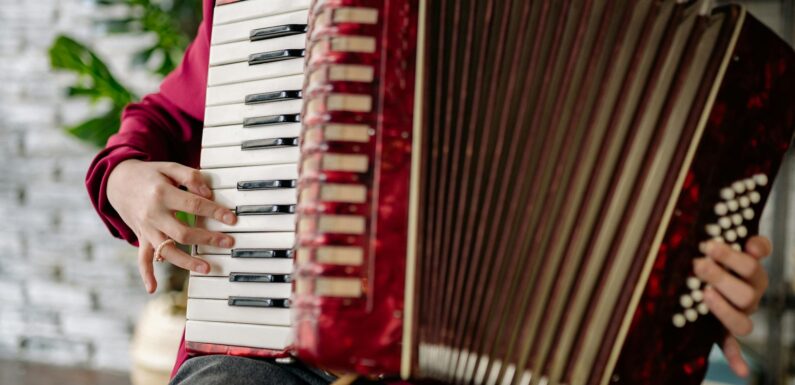
The short answer is folk and dance music, almost everywhere one exists. The accordion arrived in the 1830s, spread with migration, and was absorbed into local traditions rather than imposing a sound of its own. That is why the same instrument sounds Irish in Galway, Mexican in Monterrey and Colombian on the Caribbean coast.
Here are the genres where you will hear it most, and what the instrument is actually doing in each one.
Cajun and Zydeco, South Louisiana
Cajun music puts a single row diatonic accordion next to a fiddle and plays waltzes and two steps in French. Zydeco grew from the Creole side of the same region and took a different turn, absorbing blues and rhythm and blues, trading the fiddle for a rubboard worn on the chest. Clifton Chenier made it a touring music. Both use the accordion as a rhythm engine first and a melody instrument second.
Conjunto and Norteno, the Texas and Mexico Border
A diatonic button accordion paired with the bajo sexto, a twelve string bass guitar. German and Czech settlers brought the instrument and the polka to south Texas in the nineteenth century, and border musicians kept both and made them their own. Narciso Martinez recorded the template in the 1930s and Flaco Jimenez carried it into the mainstream.
Vallenato, Colombia
Accordion, caja drum and guacharaca scraper, from the Magdalena region on the Caribbean coast. The accordion carries long melodic lines over a rolling rhythm, and the tradition is strong enough that UNESCO added it to its heritage list in 2015.
Forro, Brazil
Accordion, zabumba drum and triangle, from the northeast. Luiz Gonzaga took it from regional dance music to a national style in the 1940s, and the accordion does the singing between the vocal lines.
Tango, Argentina
Strictly this is the bandoneon, a cousin of the accordion rather than the instrument itself. It was built in Germany, shipped to Buenos Aires, and became so central to tango that Astor Piazzolla wrote concert music for it. No other free reed instrument has that kind of repertoire.
Irish and Scottish Traditional Music
Button accordion and melodeon, playing jigs, reels and hornpipes alongside fiddle and flute. The push and pull of a diatonic box suits the bouncing rhythm of a reel, which is why it took hold here so quickly.
Klezmer and Balkan Music
Fast, heavily ornamented, and built on modes that sit outside major and minor. The accordion took over much of the harmonic work that other instruments had done, because one player could cover melody and chords at a wedding.
Russian and Eastern European Traditions
The garmon and the larger chromatic bayan. The bayan is the instrument behind most classical accordion writing, and Russian conservatories have taught it for a century.
European Dance Music
Polka from Bohemia, Italian liscio, French musette in the Paris dance halls, Finnish tango and Scandinavian gammaldans. All built on the accordion because it could fill a hall before anyone had amplification.
Why Folk Music and Not Orchestras
Three practical reasons. It was loud, so one player could carry a dance. It was self contained, with melody in the right hand and bass and chords in the left, so a village did not need a band. And it was cheap enough to own, which no orchestral instrument was.
The Smithsonian Folkways collection has field recordings from most of these traditions if you want to hear the differences rather than read about them, and the rest of the music writing here goes further into the individual styles.
